Blog

Top 20 Domain Search Keywords in December

In December 2011, over 1.1M domain name ideas were generated at NameStation. The following are the Top 20 keywords used in all domain searches combined.

To have a better chance of finding a suitable domain with competitive words, consider combining them with Themes that may seem like an unconventional match (e.g. “cloud” + Energy) or using alternative keywords.

  1. web
  2. tech
  3. cloud
  4. travel
  5. design
  6. my
  7. social
  8. shop
  9. go
  10. media
  11. job
  12. local
  13. pro
  14. android
  15. match
  16. game
  17. health
  18. bit
  19. mobile
  20. ad

Keyword search just got easier

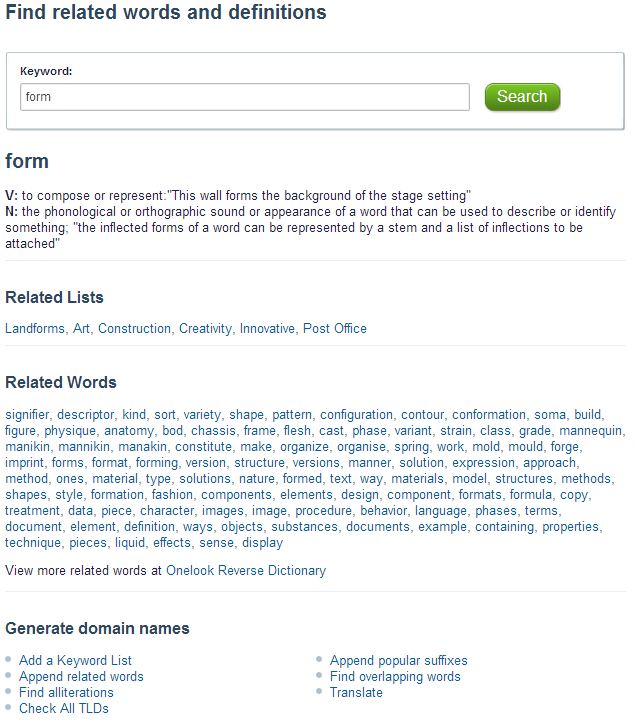
Today we launched a small but potentially very useful UI update. Clicking on any word  brings up the dialog box with the definition and hyphenation. It also enables one-click continuous searching across all search types.

  • The Dictionary link opens Google’s Definitions with synonyms and translations.
  • Related Terms goes to Onelook Reverse Dictionary. It’s a really useful tool for finding alternative keyword ideas and worth trying.
  • Wordnet is a super-thesaurus that displays semantic data and relations for each word.

Go to domain search to try it.

$5 domain registration at GoDaddy


This weekend only – the world’s largest registrar GoDaddy is offering 1-year .com  domain registration for $5 only!

Click here for the discounted price. 

New Feature: Aftermarket domain contests

Contest holders can now choose to receive domain  suggestions that are taken and sold on the aftermarket. There is also an option to specify the budget limit.

The list of contests accepting aftermarket entries already has a couple of entries with significant budgets. If you own a domain that would suit the contest requirements, please feel free to post a suggestion!


55 available domains for Halloween

Need a domain name for Halloween? All of these domain names are available as of October 31, 2011, 1:30 PM EST. Grab them now before someone beats you to it!

Click here to generate more


Top 25 domain search affixes with alternatives

Each day, thousands of domain searches at NameStation are performed with common keywords.

The top 10 words account for about 50% of the searches and clearly there is a lot of demand for available domain names with those affixes. Here is a list of alternatives that you might consider when searching for available domains.

To find available domains with any of these words, simply Append affixes or find domains by Similarity.

  1. web – online, page, site, home, dot, point, channel, link, click, source, gate, world
  2. cloud – stratus, nebula, cirrus, air, grid, mesh, space, ether, sky, serve, virtual, stack, thin, agile, open
  3. tech – vac, tron, matic, gadget, logic, sys, digi, robo, auto, mill, motor, rocket, rational, kit, suite, unit
  4. business – focus, vision, solutions, alliance, advisor, commerce, office, suite, team
  5. deal – save, bargain, budget, cent, dime, discount, drop, less, offers, penny, promo, sale, value, wallet
  6. studio – atelier, gallery, lot, scene, location, floor, workshop, forge
  7. social – club, group, circle, buddy, connect, crowd, folk, forum, guild, lodge, mate, meet, member, mix, nation, network, nexus, pal, people, public, quorum, set, summit, team, tribe, world
  8. design – adapt, create, custom, illustrate, model, shape, form, figure, pattern, make, build, frame, style, variety, class, prototype
  9. my – self, ego, own, id, take, be, personal, private, secret, inner
  10. shop – boutique, store, market, bazaar, browse, outlet, retail, commerce, vendor, mart, order, merchant, purchase, buyer
  11. photo – pic, picture, scene, screen, shoot, shot, snap, studio, film, focus, flash, frame, image, lens
  12. game – arcade, compte, contest, goal, mark, player, score, team, trophy
  13. buy – cart, catalog, purchase, outlet, store, seller, trade, sale
  14. media – connect, interactive, link, report, scoop, public, story, bulletin, broadcast, message, topic
  15. smart – brilliant, bright, clever, creative, fox, guide, genius, insight, inspire, intellect, master, mind, prodicy, sharp, specialist, talent, wise, virtuoso
  16. host – online, site, server, home, domain, digital, website, access, gate, route, avenue, channel, station, click
  17. net – grid, signal, relay, comm, contact, mesh, wire, connect, zone, maze, node, transmit, transfer, pipe, send, scan, post, traffic, uplink, tube, cirquit
  18. ad – promo, advert, sell, hype, target, push, drive, boost, campaign, press, force, promote, reach, agency, market, info, target, contact, deliver
  19. green – fresh, foliage, leaf, sustainable, preserve, sustain, viable, future, vision
  20. go – run, move, travel, jump, act, walk, drive, step, ride, start, launch, begin, enter, embark, kickoff, fire, spring, init
  21. pro – expert, ace, maven, analyst, strategist, master, guru, wizard, hotshot, genius
  22. app – use, work, utility, device, gizmo, kit, tool, run
  23. trip – getaway, leave, leisure, travel, hike, expedition, explore, tour, holiday, journey, passport, sights, takeoff, trail, vacation, wander
  24. easy – accessible, bare, basic, breeze, convenient, fot, handy, plain, pure, ready, simple, smooth
  25. data – input, format, record, info, stats, table, file, stack, archive, list, storage, save, log, book, track, ledger

Generate random domains, hear the pronunciation

Not sure how a made up name sounds in English?

The unofficial Google’s Text-to-speech API has now been integrated with NameStation’s domain name generators.  Simply click on the speaker icon next to the name to bring up the media player.

This is an experimental feature, it may not work well with all web browsers. Have you used it yet, do you find it helpful?

Try it here

Domain sale information from Sedo

If purchasing a domain from the aftermarket fits your budget, you’ll be pleased to know that NameStation now has basic Sedo integration. Sedo is the world’s largest domain marketplace, and your budget permitting, there are often affordable offers you might want to consider.

If a domain is listed in Sedo, a link is added to the Fast Domain Check results.

User Guide

How to use NameStation most efficiently?  Following this guide will instantly increase your domain search expertise. 

NameStation’s domain search tools are grouped into 3 categories:

  • Random Names - no keyword is required
  • Keyword Domains - search with a single word
  • List Searches - searches based on lists of words

Random Names

Feeling lucky? The simplest way to create made up names with no meaning is by spinning the Random Name Generator. Such names may have no meaning at all, therefore they won’t invoke any associations with your area of business or niche. However, names like these can be very distinctive and may become great brands – e.g. Plaxo, Meebo, Zynga. 

To get more variations, experiment with other languages like Latin or Italian. If you don’t care about pronunciation, select Random Letters from the Language list.

The Prefix and Suffix are optional. This can be a single character or a short word, e.g. a, go, dev. Try clicking Select underneath the text boxes. This brings up a list of short affixes, if the box is empty. If there is a keyword in the box, it brings up a list of alternative keywords and the word definition. Simply click on any of those words to run a search.

Keyword Domains

Naturally, the basis for any meaningful name is a real word. There are limitless ways words can be combined, twisted, affixed, blended, shortened and so on. Even before you start the search, it helps tremendously if you have a list of suitable words that are somehow relevant to what you’re naming. If you have no time for this, don’t worry, we have over 150 preset lists with about 20000 selected words that you can begin with.

Consider starting your quest with creating a Name Contest (even if you’re the only one working on it). Think of it as a private naming project. It helps you organize name ideas and keywords. Perhaps you’ll want to share the contest later on to get feedback.

To every Contest you can add any number of keywords, which are then used in Domain Search forms. About 20-30 keywords should get you started.

Here’s a technique that helps you find 30 keywords in less than 5 minutes. Let’s say you need a name for a reviews website. The first words that come to mind are review, rate, compare, feedback, score. Add them to your Contest. Then, open up Onelook Reverse Dictionary and look for alternative words.  Searching for score brings up hundreds of words, e.g. rank, merit, assess, value, judge, critic, evaluate etc. Even if some of these are only remotely relevant, you have nothing to lose if you add them to your Contest. You’ll be surprised how well blending or combining them will work. Go on and search also with the newly added words. Evaluate brings up grade, mark, appraise, gauge, praise. All these are a great for a reviews-related website.

An alternative to adding words to a Contest is starting your own Wordlists, which can be used in Domain Searches the same way as Contest Keywords.

For names with a clearer meaning, let’s take a closer look at some of the more advanced features we are offering.

Compound names

Putting two words together offers a limitless number of combinations for unique meaningful names. They may be a bit longer than other kinds of names, but they’re relatively easy to find and good for SEO. WordPress, Netvibes, Firefox, Facebook, Bloglines are all examples of great compound names.

Add Lists

A good place to start is Adding Lists to a keyword.  Choose from over 150 collections of words to create combined names. You can also select your Custom Wordlists or Contest Keywords. Simply click on Browse underneath the dropdown box to see all available Lists.

Most people find Conceptual Lists especially helpful. E.g. the Fast list has words that relate to speed (lightningcheetahexpress). If you need a name for a banking product, try lists like Secure, Strong, Unique.

For an automotive blog, try Vehicles and Driving. For a healthy recipes site, try Vegetables, Fruits – you get the idea.

Which primary keyword to use? Some of the most popular keywords being used are tech, web, cloud, pro which rarely bring up good available combinations. Instead, try to widen your search as much as possible. So in addition to pro, you can try smart, think, focus, expert, talent – such alternatives can be easily found with Onelook.

If you created a collection of words earlier, you can combine the entire list with other lists as described in the following passage.

Combine Lists

In addition to appending a list to a single keyword, you can Combine two lists, e.g. Travel+Comparison. Or Your Contest Keywords+Unique etc.

This is where the list of words you saved earlier becomes most useful. Given that you have assembled a long enough list of base words, finding suitable names should be a breeze.

Some of the unconventional list combinations may produce unique gems of names. Think out of the box, try unconventional lists – e.g.  Containers, Shapes, Sounds. Take a moment and explore all available lists. Some of them apply for almost any occasion, e.g. Prefixes, Suffixes, Top Keywords, English Prefixes, Search, Dynamic.

Alliterations

The Alliterations search is another way of creating Compounds by appending words that have the same sound with the word you entered.  Examples of such names would be Coca-Cola, PayPalBorders Books, Donald Duck.

Entering Apple will produce AppleAppletAppleAppeal etc. Best matches are listed first. With the search options you can choose, whether to prepend or append the alliterative words. You can also choose to match the endings of the words to produce ApplePeopleAppleRipple etc..

Blends

Blends consist of two parts, at least one of which is a portion of a word rather than a whole word  - e.g. TechnoratiWikipediaNetscape. Blends can be short, elegant and memorable and have all the advantages of compound words.

Variations

The Variations Search creates Blends by finding dictionary words that partially overlap with your keyword. Entering Domain will produce DomaindexDomainspire etc. Best matches are listed first.

In addition to complete keywords, try partial words to find overlaps. Start with Innovate, then try innov, inno, innove etc.

Blend Lists

Blending Lists is one of the most popular ways to search at NameStation and for a reason. This is again one of those searches where Contest Keywords or a niche wordlist becomes handy. Simply select 2 lists of words, choose the desired length and run the search to create randomly blended words.

Short names have 5-6 characters but are mostly taken. Your best bet would be Medium length, which have about 6-8 characters.

Part 2 coming soon …


The Magic of Verbing

Image: Nick Bilton/The New York Times

During the last couple of years, an increasingly popular phenomenon has gained attention in the field of marketing – the verbing of business names.

One of the most notable examples is naturally Google, a word that is probably applied more often as a verb than a company name. While today many start-ups consciously opt for names that can later be easily turned into verbs as a part of their branding strategy, this has not always been the case.

In the past, companies were not particularly fond of the idea of verbing their brand names. They feared losing control of their brand, that one day the verb could become so general it would start to signal all the similar products in the market, distancing itself from its original meaning. Finally, you could end up with a genericised trademark and lose your legal protection, like happened with Aspirin, Thermos, Zipper or Butterscotch.  Consider the case of Xerox, who put a lot of effort into encouraging its customers to ‘photocopy’ their papers instead of “xeroxing” them. While the company has somehow managed to preserve its trademark, there are now plenty of people who “xerox” their documents even on HP or Canon machines. Moreover, the meaning of the word has evolved even further, so when someone calls you a Xeroxer, it means you have probably been copying someone else’s style, ideas or possessions.

Do such developments still pose a real threat to companies? Presumably, but we have reached the point where businesses are increasingly starting to notice the benefits of verbing. First and foremost, it is one of the most effective means of extending brand recognition. Google was one of the first companies to take advantage of this, hoping that the popularity of “googling” would translate into more people opting for that particular search engine instead of its competitors.  The Irish author Oscar Wilde has successfully managed to summarise the idea behind it into one sentence: “There is only one thing in the world worse than being talked about, and that is not being talked about.” Even Microsoft is trying to apply this knowledge to its search engine Bing – so next time you are looking for information, you might want to “bing” it instead of “googling” it. Or perhaps not. Bing has probably missed the train, since “googling” has already become too strongly associated with the process of using an Internet search engine, it might be a rather futile attempt to dethrone the word. More likely, people will eventually end up “googling” on Bing rather than “binging”. While the threat of losing their trademark is still there for Google – a triumph for Microsoft, no doubt –, the search engine has already benefited more from verbing than it could possibly lose in the future.

Why some businesses turn into verbs and others don’t?

This is not something that is thoroughly dependent on the company’s strategy. While you can choose a name whose characteristics give it greater potential to be verbed or encourage people to use your name as a verb, you normally cannot make this decision for them. More often than not companies with the most impact on human experience coin new verbs; therefore, what you are offering matters more than the features of the name itself. At first PayPal probably did not seem like the case for potential verbing, however, by now it is common to “paypal” money instead of shipping it.

Many company names have turned into verbs because the offered services or products have been revolutionary or innovative in some ways. Google benefited from the fact that beforehand there was no exact term to denote conducting an Internet search. The same happened with Skype. Xerox, on the other hand, probably caught on because earlier photocopying had not been exactly something you would do on a daily basis. Another aspect to the matter is that the verb should denote one particular activity.   After all, despite the popularity, we still don’t Apple, PowerPoint, Excel or Novell. If you “powerpointed” something, what would you actually be doing? Creating a PowerPoint presentation? Conducting a PowerPoint presentation? Or maybe neither of those actions. And even if you actually used PowerPoint a lot, it isn’t really that common a topic that you would talk about often enough for it to become a verb.

Sometimes it does not even have to be the exact name of the business that is verbed.  Consider Twitter and “tweeting”, a word singularly associated with the company and its website.  Or what about “unfriend”? I dare say there is only one company this word can remind you of and while you may unfriend people in many social networking sites, we first think of Facebook. Consequently, in marketing it is not always important that the verb is the exact copy of your business name, while more attention should paid to having certain words associated with your company instead. So when someone mentions “followers”, no matter the context, your brain very likely registers “Twitter”, even if it is just for a second, and the next time you sit at your computer, the previous event makes you subconsciously go to the page and tweet something.

Which names are you using as verbs in everyday communication?